

Key takeaways: FATF plenary October 2026
- Plenary dates: 28 to 30 October 2026, Paris. It was the first plenary under the UK Presidency of Giles Thomson.
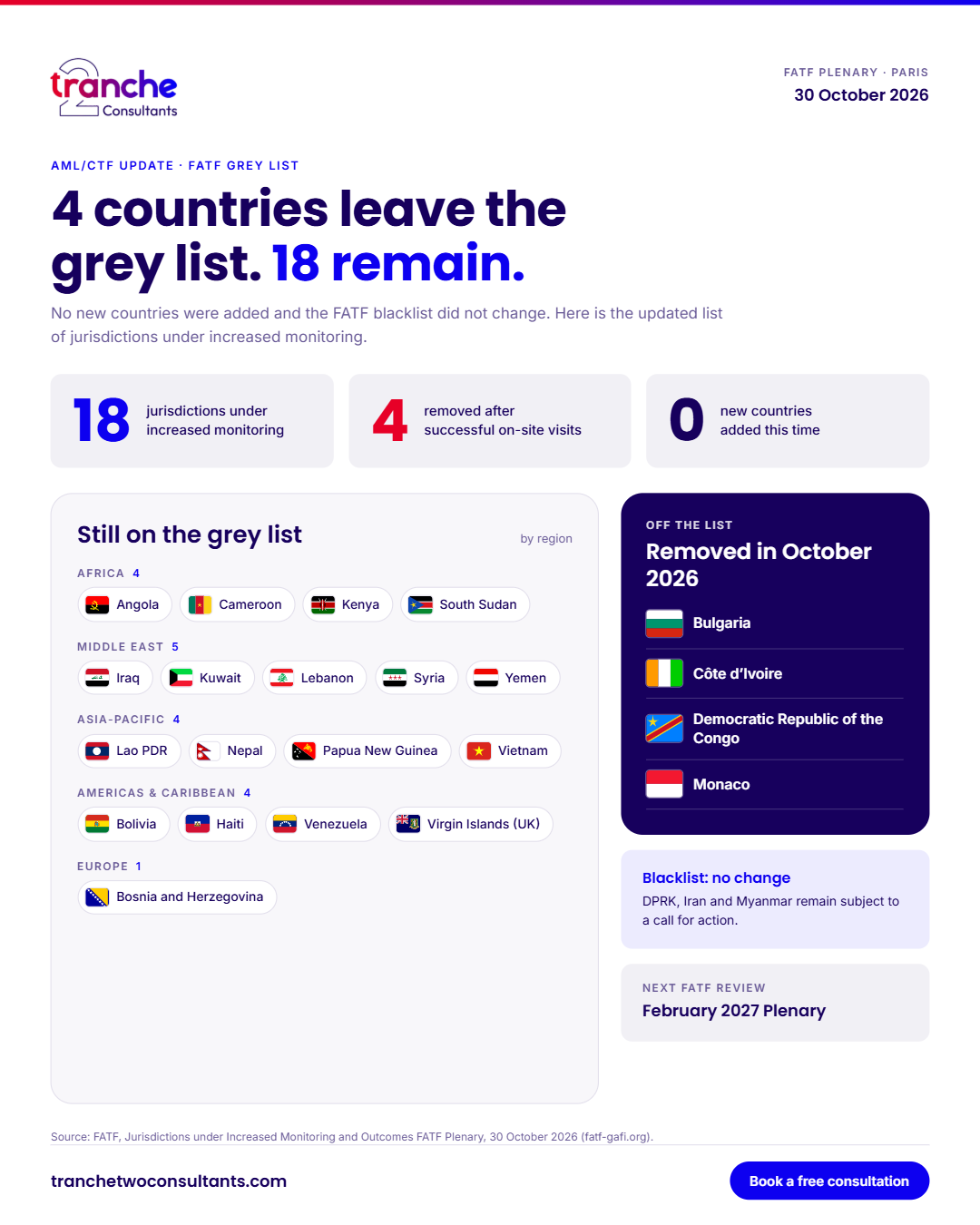
- Removed from the grey list: Bulgaria, Côte d’Ivoire, Democratic Republic of the Congo and Monaco.
- Added to the grey list: None.
- Grey list size: 18 jurisdictions (22 after the June 2026 plenary).
- Blacklist: No change. Iran and DPRK face countermeasures. Myanmar faces enhanced due diligence.
- Warnings: Vietnam and Myanmar must show real progress by February 2027.
- New focus: Fraud and scam compounds, plus a faster review of virtual asset standards.
- Next plenary: 22 to 26 February 2027.
- For Australia: Update your ML/TF risk assessment, country risk list and enhanced CDD triggers, and keep a record of the change.
The FATF update October 2026 removed four countries from the grey list and added none. Bulgaria, Côte d’Ivoire, the Democratic Republic of the Congo (DRC) and Monaco are no longer under increased monitoring. The grey list now has 18 jurisdictions, down from 22. The blacklist did not change: Iran, North Korea (DPRK) and Myanmar stay on it.
This is the first FATF plenary since Tranche 2 obligations started in Australia on 1 July 2026. For many lawyers, accountants, real estate agents, conveyancers and trust and company service providers, it is the first FATF list change they must reflect in their own AML/CTF program. This guide explains what changed, why it changed, and what AUSTRAC reporting entities should do now.
What changed in the FATF update October 2026?
The FATF published its updated statements on 30 October 2026, at the end of the Paris plenary. Four countries left the grey list after completing their action plans. No country was added, and the blacklist stayed the same.
Countries removed from the FATF grey list in October 2026
| Country | On the grey list since | Removed | Approx. time listed |
|---|---|---|---|
| Democratic Republic of the Congo | October 2022 | 30 October 2026 | 48 months |
| Bulgaria | October 2023 | 30 October 2026 | 36 months |
| Monaco | June 2024 | 30 October 2026 | 28 months |
| Côte d’Ivoire | October 2024 | 30 October 2026 | 24 months |
Is Your AML/CTF Risk Assessment Up to Date?
Keep your country risk ratings in line with the latest FATF lists.
Countries added to the FATF grey list in October 2026
None.
FATF grey list countries as of 30 October 2026 (18)
The official name of the grey list is “Jurisdictions under Increased Monitoring”. These countries are working with the FATF to fix gaps in their AML/CFT/CPF systems.
- Angola
- Bolivia
- Bosnia and Herzegovina
- Cameroon
- Haiti
- Iraq
- Kenya
- Kuwait
- Lao People’s Democratic Republic
- Lebanon
- Nepal
- Papua New Guinea
- South Sudan
- Syria
- Venezuela
- Vietnam
- Virgin Islands (UK)
- Yemen
Note: Bosnia and Herzegovina, Haiti, Iraq and Yemen did not send progress updates this cycle. The FATF carried forward their earlier statements.
FATF blacklist countries 2026 (unchanged)
The official name of the blacklist is “High-Risk Jurisdictions subject to a Call for Action”.| Country | What the FATF asks countries to do |
|---|---|
| Iran | Apply countermeasures |
| North Korea (DPRK) | Apply countermeasures |
| Myanmar | Apply enhanced due diligence proportionate to the risk |
Why were Bulgaria, Côte d’Ivoire, the DRC and Monaco removed?
Each country completed its agreed FATF action plan, and an on-site visit confirmed the reforms are working in practice. The FATF does not delist a country only because it passes new laws. It checks for real results, such as better beneficial ownership data, useful financial intelligence and actual prosecutions.
Bulgaria
Bulgaria made sure its beneficial ownership register holds accurate and up-to-date information. It also improved money laundering investigations and prosecutions linked to high-level corruption and organised crime. Other gains include risk-based supervision of money transfer operators, currency exchanges and real estate agents, and stronger entry controls for virtual asset service providers.
Côte d’Ivoire
Côte d’Ivoire improved international cooperation on money laundering and terrorist financing cases. It brought in risk-based supervision of financial institutions and DNFBPs, and made beneficial ownership information easier to check. It also made better use of financial intelligence and improved its targeted financial sanctions.
Democratic Republic of the Congo
The DRC completed its national ML/TF risk assessment and adopted a national AML/CFT strategy. It named supervisors for DNFBP sectors and built a risk-based supervision plan. It also gave its financial intelligence unit more resources and showed working targeted financial sanctions for terrorist and proliferation financing.
Monaco
Monaco built a better understanding of money laundering risk linked to tax fraud committed abroad. It improved the quality and speed of suspicious transaction reporting and enforced beneficial ownership rules more strictly. It also sent more requests to foreign authorities to trace and seize criminal assets.
Delisting is a milestone, not the finish line
At the plenary press conference, FATF President Giles Thomson said grey list removal is not the end of the road for these countries. Their regional bodies will keep checking that the reforms last. Risks such as corruption, organised crime and sanctions exposure still need to be assessed on their own facts.
What does the FATF update October 2026 mean for Australian reporting entities?
The October changes do not create a new law in Australia. They do change one input in your ML/TF risk assessment, so your AML/CTF program needs a documented update. AUSTRAC expects reporting entities to know which countries pose higher ML/TF risk and to use that knowledge in risk assessments, compliance programs and suspicious matter reporting decisions.
Blacklist countries: enhanced CDD is mandatory
Under the amended AML/CTF Act 2006, you must apply enhanced customer due diligence where any of these people are physically present in, or formed in, a high-risk jurisdiction for which the FATF has called for enhanced due diligence:
- your customer
- your customer’s beneficial owner
- a person on whose behalf your customer receives the designated service
Today that means Iran, North Korea and Myanmar. Iran and North Korea are also “prescribed foreign countries” under Australian law, and Australian sanctions laws apply separately. Because the blacklist did not change, these triggers stay exactly as they were.
Grey list countries: a risk factor, not an automatic trigger
The FATF does not ask countries to apply enhanced due diligence only because a country is grey-listed. In Australia, grey list status feeds into your foreign jurisdiction risk when you rate customers, transactions and delivery channels. A customer linked to a grey-listed country may still need enhanced CDD if your overall risk rating is high.
Delisted countries: review, do not auto-downgrade
Removal from the grey list does not make a customer low risk. Before you lower a rating for a client linked to Bulgaria, Côte d’Ivoire, the DRC or Monaco, look at the full picture:
- the customer’s source of funds and source of wealth
- complex ownership structures and beneficial owners
- sanctions and PEP exposure
- adverse media and corruption risk in that country
- the type of service, such as property, trust or company work
Record why any rating changed. AUSTRAC can ask to see the reason.
Avoid de-risking whole groups of customers
The FATF reminds firms that its standards do not support cutting off entire classes of customers. It asks for a risk-based approach that does not disrupt humanitarian aid, legitimate not-for-profit work or remittances. If you exited clients from Côte d’Ivoire or the DRC only because of grey list status, check whether that decision still matches the risk.
Why this matters more for Tranche 2 businesses
Tranche 2 obligations started on 1 July 2026. Many new reporting entities built their first country risk list using the June 2026 FATF statements. That list is now out of date. Lawyers, accountants, real estate agents and conveyancers often handle cross-border property deals, trusts and company structures, where country risk is a key red flag. Updating your list now shows AUSTRAC that your program is live and maintained, not a one-off document.
International clients: other lists may still apply
If you also work with UK or EU clients or partners, note that their lists can differ. The European Commission’s high-risk third country list still names Côte d’Ivoire, the DRC and Monaco until it is formally updated. Keep FATF status and other regulators’ lists as separate fields in your country risk table.
Are Your AML Controls Working?
Find gaps in your screening and monitoring before AUSTRAC does.
Other outcomes from the FATF plenary October 2026
The October plenary was not only about country lists. Two countries received February 2027 deadlines, and fraud moved to the top of the FATF agenda.
Vietnam: warning ahead of February 2027
Vietnam has been on the grey list since June 2023, and all its action plan deadlines expired in May 2025. The FATF expressed significant concern about its slow progress. It expects tangible improvements by February 2027, or it will consider next steps. Open items include regulating virtual assets and VASPs, accurate beneficial ownership information, and monitoring of proliferation financing sanctions.
Myanmar: countermeasures decision moved to February 2027
Myanmar stays on the blacklist with enhanced due diligence, not countermeasures. In June, the FATF had said it would consider countermeasures in October 2026. It has now moved that checkpoint to February 2027. The FATF again called on Myanmar to tackle its extensive fraud and scam activity.
If your clients, counterparties or payments have links to Vietnam or Myanmar, plan for a possible tougher outcome now.
Scam compounds become a global priority
The plenary approved a report on the end-to-end money flows behind scam compounds. These are large criminal operations that run romance, investment and “pig butchering” scams, often using trafficked workers. The report draws on more than 100 case studies across Africa, Europe, Central America, and Southeast and East Asia. It is the first output of the FATF’s fraud roadmap under the UK Presidency.
For Australian businesses, scam money often moves through real estate, trust accounts, mule accounts, instant payments and virtual assets. Review your transaction monitoring and red-flag indicators once the report is published.
Faster review of virtual asset standards
The FATF agreed to a targeted review of countries with materially important virtual asset sectors. Results are due in June and October 2027. Digital currency exchanges and other firms with crypto exposure should keep their travel rule controls and counterparty checks up to date.
Mutual evaluations and the risk-based approach
The FATF adopted the mutual evaluation reports of Mexico and the United States, to be published in December 2026. It will also host a forum in Dallas on 1 to 2 December 2026 to agree a policy statement on how the risk-based approach should work in practice.
What should AUSTRAC reporting entities do now?
Use this checklist to bring your AML/CTF program in line with the October 2026 FATF statements.
- Update your ML/TF risk assessment. Change the foreign jurisdiction risk inputs for Bulgaria, Côte d’Ivoire, the DRC and Monaco. Record the date of the 30 October 2026 FATF statements.
- Refresh your country risk list. Remove the four countries from your grey list column. Keep Iran, North Korea and Myanmar flagged for mandatory enhanced CDD.
- Find affected customers. Pull a list of customers, beneficial owners and counterparties linked to the four delisted countries, Vietnam and Myanmar.
- Re-rate with reasons. Review each affected customer’s risk rating. Lower it only where the wider risk supports it, and write down why.
- Update screening and monitoring rules. Change country lists in your screening tool and transaction monitoring rules so alerts work correctly.
- Check your SMR triggers. Country status alone is not a reason to report. Submit a suspicious matter report to AUSTRAC when you form a suspicion.
- Brief your team. Tell your AML/CTF compliance officer, senior manager and front-line staff what changed. Add it to your next AML training session.
- Diarise February 2027. Set a reminder to review Vietnam and Myanmar after the 22 to 26 February 2027 plenary.
Need help updating your AML/CTF program?
Tranche 2 Consultants helps Australian reporting entities keep their AML/CTF programs current after every FATF update.
FAQs on the FATF update October 2026
Which countries were removed from the FATF grey list in October 2026?
Bulgaria, Côte d’Ivoire, the Democratic Republic of the Congo and Monaco were removed on 30 October 2026. Each completed its FATF action plan and passed an on-site visit.
Were any countries added to the FATF grey list in October 2026?
No. The FATF did not add any country to the grey list at the October 2026 plenary.
How many countries are on the FATF grey list now?
As of 30 October 2026, 18 jurisdictions are on the FATF grey list. There were 22 after the June 2026 plenary.
Which countries are on the FATF blacklist in 2026?
Iran, North Korea (DPRK) and Myanmar. The FATF calls for countermeasures against Iran and North Korea, and enhanced due diligence for Myanmar.
Do Australian businesses need enhanced CDD for grey list countries?
Not automatically. Enhanced CDD is mandatory for blacklist countries where the FATF has called for enhanced due diligence. Grey list status is a risk factor, and you must apply enhanced CDD if your overall assessment rates the customer as high risk.
Can I lower the risk rating of a client from Monaco or Bulgaria now?
Possibly, but not automatically. Review the client’s ownership, source of funds, sanctions exposure and other risk factors first. Document the reason for any change.
Is Vietnam still on the FATF grey list?
Yes. The FATF raised significant concern about Vietnam’s slow progress and expects tangible improvements by February 2027.
When is the next FATF grey list update?
The next FATF plenary is scheduled for 22 to 26 February 2027. Updated lists usually come out on the last day of the plenary.